Updated September 2026 — refreshed against the live PES catalog; product pricing verified 2026-09-26.
2026 product line update
| Product | Class | Price |
|---|---|---|
| Canadian Solar 710W TOPCon Bifacial Solar Panel | 710W | $340.80 |
| Hyundai 640W 156-Cell TOPCon Bifacial Solar Panel | 640W | $220.78 |
| Thornova Solar TS-BGT72(600) 600W Bifacial Solar Panel | 600W | $165.76 |
| Thornova Solar 595W Solar Panel 144 Cell Bifacial TS-BGT72(595) Wholesale 31 panels per pallet | 595W | $164.64 |
| ZNShine Solar 585W 144-Cell Bifacial Solar Panel | 585W | $246.99 |
| Hyundai HiS-S585OJ 585W Clear on Transparent156 Half-Cell Bifacial Solar Panel | 585W | $195.86 |
Live prices verified 2026-09-26. The current pallet line tops out at 550–640W, plus the Canadian Solar 710W TOPCon flagship panel.
Affordable Solar Panels: A Comprehensive Buyers Guide to Save Money and Maximize ROI
Dollars per watt, efficiency trade-offs, degradation math, warranty reality, and the buying moves that cut cost without cutting quality.

We sell solar panels by the pallet, so let us tell you the truth about "affordable": the cheapest panel per watt is rarely the cheapest panel per kilowatt-hour over twenty-five years. The real math folds in efficiency (how many watts fit on your roof), degradation (how fast those watts fade), warranty (who answers the phone in year twelve), and freight (a pallet of glass is not a book order). This guide runs all of it with real 2026 numbers, so you can buy once and buy right.
Panel pricing moves, but the structure doesn't. At wholesale, mainstream tier-one mono PERC panels trade in the low-to-mid $0.20s per watt in pallet quantities, premium N-type TOPCon and HJT panels run $0.30–0.45, and boutique or domestic-assembled product prices above that. Retail single-panel buyers pay more per watt — that's logistics, not markup greed; shipping one 50-pound glass sandwich costs a real fraction of the panel itself. A single 400W panel shipped alone might carry $60–90 of freight; the same panel in a 31-piece pallet carries under $10.
| Panel Tier | Typical $/W (pallet qty) | Efficiency | Best Use |
|---|---|---|---|
| Value mono PERC (400–450W) | $0.22–0.28 | 20.5–21.5% | Ground mounts, big roofs, budget projects |
| Mainstream N-type TOPCon | $0.26–0.34 | 21.8–22.8% | Residential rooftops, space-constrained |
| Premium HJT / back-contact | $0.34–0.45 | 22.5–23.5% | Max production per square foot |
| Bifacial dual-glass | $0.28–0.40 | 21–23% (+5–15% rear gain) | Ground mounts, carports, high-albedo sites |
The counterintuitive part: on a residential roof, the premium panel is often the affordable one. Balance-of-system costs — racking, labor, permitting, electrical — run $1.50–2.50 per watt regardless of panel choice. Higher-efficiency panels mean fewer panels, fewer rails, fewer clamps, fewer roof penetrations, and less labor for the same nameplate kilowatts. We've quoted jobs where stepping up $0.08/W on the module added $450 to the panel line and saved $600 in racking and labor. Do the whole-system math before you fall in love with a cheap sticker. Browse current inventory across the 400–459W class and 400W panels to see live pricing.
Efficiency is watts per square foot, and it matters exactly as much as your roof is small. A 400W panel at 20.5% efficiency and a 460W panel at 22.8% differ by about 60 watts on roughly the same footprint — call it 15% more power from the same screws. On a wide-open ground mount, buy the cheaper panel and add a row. On a hip roof fighting vents and setbacks, the premium panel buys capacity no money can add later.
| Scenario | Roof Area | Value Panels (400W) | Premium Panels (460W) | Winner |
|---|---|---|---|---|
| Small hip roof | 350 sq ft usable | ~8 panels / 3.2 kW | ~8 panels / 3.7 kW | Premium (+15% kWh) |
| Standard gable roof | 600 sq ft usable | 14 panels / 5.6 kW | 14 panels / 6.4 kW | Toss-up; price decides |
| Ground mount, open field | Unlimited | 24 panels / 9.6 kW | 24 panels / 11 kW | Value (space is free) |
| Commercial flat roof | Ballast-limited | Fewer, cheaper | More kW per ballast point | Premium often wins |
One caution on chasing nameplate watts: panel dimensions creep with wattage. The current 440–460W residential-format modules run about 75 × 41 inches; some 550W+ "residential-adjacent" modules are commercial-format at 89 × 42 inches and awkward on rafter layouts. Match the module format to the roof, not just the wattage to the wish list. Our best panels of 2026 roundup keeps current dimensions and pricing side by side.
The alphabet soup matters less than the behavior, so here is the counter-level translation. Mono PERC is the mature incumbent: cheap to make, well understood, degrades around half a percent a year, and perfectly good for most roofs. N-type TOPCon is the current mainstream upgrade — higher efficiency, better heat behavior, slower degradation — and in 2026 the price premium over PERC has compressed enough that we recommend TOPCon for any space-constrained residential roof. HJT (heterojunction) runs the best temperature coefficients in the business, which matters in hot climates where panels cook at 65°C cell temperature all summer; expect the highest sticker and the slowest fade. Bifacial dual-glass harvests reflected light on the rear side — real gains of 5–15% on ground mounts over gravel or bright membrane roofs, near zero on a flush shingle roof. We've watched customers pay bifacial premiums for flush mounts; the rear side of a flush-mounted panel sees nothing but roofing felt.
Temperature coefficient deserves one concrete number because it moves real money in hot states. PERC typically loses about 0.34–0.35% of output per °C above 25°C cell temperature; HJT runs closer to 0.24–0.26%. On a 95°F day with cells at 60°C, that's roughly a 12% penalty on PERC versus 9% on HJT — three points of harvest every hot afternoon, forever. In Minnesota, ignore it. In Arizona, price it in.
Panels flow through three channels and each prices differently. Installers bundle module cost into a turn-key $2.50–3.50/W quote — convenient, and you're paying for design, labor, permits, and warranty service in one number. Wholesale distributors (that's us) sell panels at pallet pricing to contractors and competent owner-builders; you handle design, permitting, and installation or hire them à la carte, and save the difference. Marketplaces and liquidators sell whatever the freight damage gods delivered — occasionally a genuine bargain, often mixed date codes, no warranty path, and mystery storage history. We've tested liquidated pallets that flash-tested fine and pallets where a third of the modules showed microcrack EL signatures. If you can't verify the serial chain and storage conditions, the discount is a gamble, not a strategy.
Freight and receiving deserve their own discipline because panels are glass. Inspect the pallet before signing the bill of lading: crushed corners, fork tines through the side, shifted straps. Note damage on the delivery receipt — the words "subject to inspection" are worthless; write "visible damage, X cartons" or the claim dies. Flash-test a sample if you have the means; at minimum, open-circuit-voltage check each module with a multimeter before install day. A panel that reads dead on the ground is a warranty swap; a panel discovered dead on the roof is a labor argument.
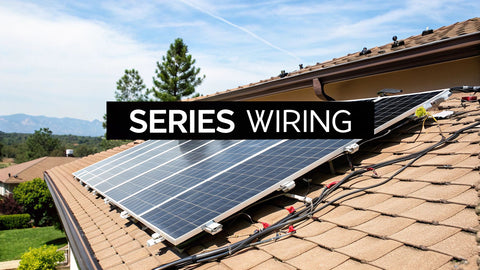
Panels price per watt, but they integrate per volt and amp. Three compatibility checks before any purchase order. Voltage window: your string's cold-weather Voc — adjusted for your record low, because voltage rises as temperature falls — must stay under the inverter's input maximum; NEC 690.7 makes this code, not preference. Rapid shutdown: NEC 690.12 requires module-level shutdown for rooftop systems; plan optimizers, micros, or module-level power electronics into the cost stack on roof jobs. Current matching: modern 182mm-cell modules push Imp past 13–14 amps; confirm the inverter MPPT input rating exceeds string Imp with margin. The full wiring math lives in our panel wiring basics guide, and conductor selection in the NEC ampacity chart guide.
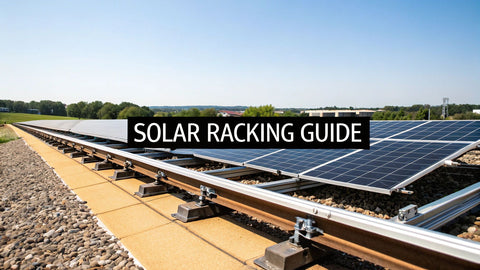
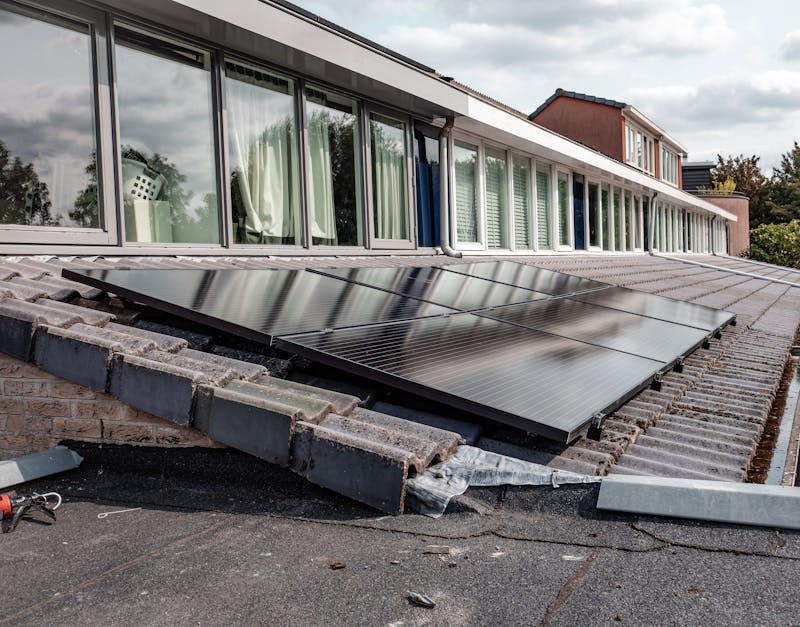
While you're budgeting the balance of system, don't forget the racking line. Flush roof mounts run roughly $0.10–0.15/W; ground mounts like our Sinclair Sky Rack ground-mount kits run more per watt but install without roof penetrations and orient perfectly. Flat commercial roofs add ballast engineering — weight, wind zones, and membrane protection — which is cheap in concrete and expensive if ignored.
Financing and the True Cost of "Free" Solar

Cash is cheapest, full stop. Solar loans at dealer-fee-inflated rates hide 15–30% dealer fees inside the principal — a "2.99% loan" with a 25% dealer fee costs more than an honest 8% loan on the cash price. Always ask any financed quote for the cash price first; the gap between the two numbers is the fee, and it's negotiable. Leases and PPAs trade ownership for simplicity: no maintenance, no tax credit (the lessor claims it), escalator clauses that eat 2–3% more of your savings annually, and a lien conversation when you sell the house. None of these are scams, but they price differently, and the affordable answer depends on your tax appetite, cash position, and how long you'll own the roof. For whole-house planning context, our whole-house solar analysis pairs well with the system size calculator.
Every panel loses output every year; the question is how fast. Modern mono PERC warranties guarantee roughly 87.4% of nameplate at year 25 (about 0.5%/yr after a first-year drop); N-type TOPCon and HJT warranty 87–89% at year 30 with first-year losses near 1%. Over a 30-year ownership horizon, that difference compounds into real money — a half-percent per year on a 10 kW array is roughly 1,500 kWh of lifetime production, call it $250–400 at retail rates. Not life-changing, but it should break ties between otherwise equal panels.
| Technology | Year-1 Degradation | Annual Thereafter | Warranted Output @ Yr 25 | @ Yr 30 |
|---|---|---|---|---|
| Mono PERC (mainstream) | ~2.0% | ~0.55% | ~84.8% | ~82% |
| N-type TOPCon | ~1.0% | ~0.40% | ~89.4% | ~87.4% |
| HJT | ~1.0% | ~0.25–0.35% | ~90–92% | ~88–90% |
| Thin-film (CdTe) | ~1.5% | ~0.4% | ~89% | varies |
Real-world degradation tracks warranty curves only if the panels live a decent life. The killers we see in warranty photos: backsheet scratches from rough handling, microcracks from stepping on modules during install (yes, people still do it), PID on poorly grounded strings, and hotspot damage from chronic shading that "the optimizer will handle." Optimizers mitigate shade; they don't repeal physics. Keep trees trimmed and keep feet off the glass.
Two warranties ride with every panel. The product warranty covers defects — delamination, junction-box failures, frame problems — and runs 12–25 years depending on tier. The performance warranty guarantees output retention, typically to 85–89% at year 25–30. Read which entity backs them: a bankable manufacturer with a US presence answers claims; a shell brand that folded in year six does not. We've processed warranty claims on behalf of customers, and the difference between a responsive manufacturer and a dead email address is the difference between a nuisance and a loss.
- Prefer 25-year product warranties on rooftop work — the cost delta is small and roofs are expensive to revisit.
- Check the labor clause. Some warranties pay removal and reinstall labor; many pay only the module. On a steep roof, labor is the expensive half.
- Keep the pallet paperwork. Serial-number sheets and the bill of lading are your claim's birth certificate. Photograph them on delivery day.
- Register the warranty. Several manufacturers require registration within 30–90 days of install to activate the full term. It takes five minutes online; we've seen claims grind for months over an unregistered array.
Storage pairing is the other warranty-adjacent decision worth making at purchase time. If batteries are in your five-year plan, buy the hybrid-capable inverter now — retrofitting means replacing the inverter, not adding to it. Our solar battery buyers guide and the battery sizing calculator will tell you how much storage your usage pattern actually justifies; most homes land between 10 and 20 kWh, not the 40 kWh the sales deck suggests.
Strip the marketing and solar ROI is arithmetic. Worked example with 2026 numbers: a 10 kW residential system in a mid-rate state (~15¢/kWh), 1,400 kWh/kWp annual yield, value-tier panels at $0.26/W, $2.60/W all-in installed.
| Line Item | Value | Notes |
|---|---|---|
| Gross installed cost | $26,000 | 10 kW × $2.60/W |
| Federal ITC (30%) | −$7,800 | Confirm current eligibility rules before quoting |
| Net cost | $18,200 | Before any state/utility incentives |
| Annual production | 14,000 kWh | 1,400 kWh/kWp × 10 kW |
| Annual savings (yr 1) | $2,100 | 14,000 × $0.15 |
| Simple payback | ~8.7 years | Faster with rate escalation (~3%/yr shortens to ~7.5) |
| 25-yr cumulative savings | ~$48,000–55,000 | Net of degradation, with 3% rate escalation |
Three levers move payback more than panel price ever will: your retail rate (solar in a 25¢ state pays back twice as fast as in a 9¢ state), your self-consumption ratio (every kWh you use beats every kWh you export at wholesale), and shading discipline. Run your own numbers through the solar ROI calculator and sanity-check system size with the system size calculator. State incentives move the needle too — our incentives-by-state page tracks them.
Buy by the pallet, not the panel
Pallet pricing routinely beats single-panel retail by 15–30% per watt, and freight per panel collapses. If your project is 15+ panels, ask for the pallet price. Our solar panel kits guide shows how kits bundle the savings.
Match format to the roof
Residential-format modules (about 75 × 41 in) lay out cleaner on rafters than commercial-format giants. Fewer cut rails, faster installs.
Design to 100–110% of usage, not 130%
Exported energy pays wholesale; self-consumed pays retail. Oversizing past your usage buys kWh at retail and sells them at pennies.
String inverters where shade allows
A quality string inverter system costs 10–20% less than micros and lasts the project. Micros earn their premium on complex shade; open roofs don't need them.
Time the buy
Panel prices soften when manufacturers clear model-year transitions — typically Q4 and early Q1. Pallet buyers who can wait, save.
Don't over-buy efficiency on open ground
Ground mounts trade space for dollars. Value-tier panels plus one more row beat premium glass when land is free.
Budget the electrical honestly
Main-panel upgrades, NEC 690 disconnects, and grounding and bonding are real line items. A cheap panel on an undersized service is an expensive surprise at inspection.
"Affordable" red flags we reject at the counter.
No-name panels with no US warranty entity. "Cosmetic seconds" without serial traceability. Pallets with mixed date codes sold as new. Any seller who can't produce the manufacturer's datasheet and warranty PDF on request. Cheap glass that fails in year four is the most expensive solar you'll ever buy.
A word on mounting real estate that surprises first-time buyers: fire setbacks eat roofs. Most jurisdictions following IFC/IRC rules require 3-foot clearances at ridges and pathways for firefighter access, and those clearances can consume 20–30% of an otherwise perfect roof plane. Lay out your array against the setback map before falling in love with a panel count. This is one more argument for higher-efficiency modules on tight roofs — when the code takes a third of your space, watts per square foot stop being a luxury and start being the whole design brief.
Finally, buy from someone who will still exist. The solar industry cycles through booms and shakeouts; the brands that survive hold parts, honor warranties, and answer phones. We curate inventory toward manufacturers with US operations and bankable balance sheets precisely because a warranty is only as good as the entity behind it. Affordable means lowest lifetime cost per kilowatt-hour — and the lifetime part is where fly-by-night bargains go to die.
Keep building the system
Sticker price is a snapshot; ownership is a movie. Here's the same 10 kW residential roof bought two ways, assuming 1,400 kWh/kWp year-one yield and a 15¢ retail rate escalating 3% annually:
| Metric | Value PERC Build | Premium TOPCon Build |
|---|---|---|
| Panels for 10 kW | 25 × 400W | 22 × 460W |
| Panel cost @ pallet pricing | ~$2,600 | ~$3,400 |
| Racking & labor delta | baseline | −$350 (fewer modules) |
| Year-1 production | 14,000 kWh | 14,000 kWh |
| Year-25 production | ~11,870 kWh | ~12,520 kWh |
| 25-yr cumulative kWh | ~317,000 | ~327,000 |
| 25-yr value of extra kWh | — | ~+$2,300 |
| Net premium payoff | — | ~+$1,850 after panel premium |
The premium build wins quietly — about $1,850 over 25 years in this scenario — but only because roof space constrained the comparison to the same 10 kW. Flip the scenario to an open ground mount where the value build simply adds a 26th and 27th panel, and value wins by a wider margin. That's the whole game: know which constraint — space or dollars — governs your project, and buy the panel that exploits it.
Owner-builders consistently underestimate the paper side, so here is the realistic sequence. Design and load calcs come first — string sizing, installation planning, and the electrical one-line your AHJ wants with the permit application. Permit review runs one to six weeks depending on jurisdiction; utility interconnection applications run in parallel and take two to eight weeks. Installation itself is two to five days for a competent crew on a standard roof. Then the waiting: inspection, utility witness or meter swap, and permission to operate. Total calendar time for a permitted owner-built residential system: eight to sixteen weeks, and the panels themselves are the fastest part. Buy them after the permit set is approved — we've consoled too many customers with a pallet in the garage and a red-tagged design because the service panel needed an upgrade nobody budgeted.
One more scheduling note from painful experience: don't take roof work and solar work in the same month by accident. If your shingles have under ten years of life, re-roof first. Removing and reinstalling an array for a re-roof costs $1,500–3,000 and is the most avoidable expense in the entire industry.
What is a good price per watt for solar panels in 2026?
At wholesale pallet quantities, $0.22–0.28/W for value mono PERC and $0.26–0.34/W for N-type TOPCon are honest bands. Retail single panels run higher due to freight. Judge panel price against the $1.50–2.50/W of balance-of-system it sits inside.
Are cheap solar panels worth it?
Value-tier panels from bankable manufacturers are excellent buys — same glass, similar cells, thinner margins. No-name panels with no warranty entity are not. The dividing line is who answers a year-twelve claim, not the sticker.
How much does a 10 kW system save per year?
At 1,400 kWh/kWp and a 15¢ retail rate, about $2,100 in year one, escalating with utility rates. In high-rate states (25¢+), the same array saves $3,500+ annually.
Do premium panels pay for themselves?
On space-constrained roofs, often yes — 15% more watts per square foot plus slower degradation compounds. On open ground mounts, usually no; cheaper panels plus more of them win the $/kWh math.
How long do affordable panels last?
Mainstream panels carry 25–30 year performance warranties and commonly produce for 35+ years. Degradation — not failure — is the norm: expect 85–90% of nameplate at year 25 from quality product.
Is it cheaper to buy solar panels in bulk?
Yes — pallet pricing typically beats single-panel retail by 15–30% per watt, and freight per panel drops dramatically. Projects of 15 panels or more should always quote pallet pricing.
Should I wait for panel prices to drop further?
Panel prices drift down over time, but balance-of-system and labor don't — and every year of waiting is a year of utility bills at retail. If the ROI math works today at your rate, the best time to buy was the quote you have in hand.
What maintenance do solar panels need?
Rain handles most cleaning; pollen-heavy or dusty regions benefit from a rinse once or twice a year. Beyond that: annual visual inspection of wiring and racking, monitoring review for underperforming strings, and tree trimming before shade becomes a hotspot problem.
Buy panels the way contractors do
Pallet pricing, freight handled, datasheets and warranties on request. Tell us your system size and roof type and we'll quote the honest options.
Shop Solar PanelsNeed pricing or availability on anything in this guide?
Portlandia Electric Supply dropships direct from the manufacturer — most items Ship Direct with lead times stated up front, no surprises.
Get a quote from PESBulk, pallet and contractor pricing available.