Updated September 2026 — refreshed against the live PES catalog; product pricing verified 2026-09-26.
2026 product line update
| Product | Class | Price |
|---|---|---|
| Canadian Solar 710W TOPCon Bifacial Solar Panel | 710W | $340.80 |
| Hyundai 640W 156-Cell TOPCon Bifacial Solar Panel | 640W | $220.78 |
| Thornova Solar TS-BGT72(600) 600W Bifacial Solar Panel | 600W | $165.76 |
| Thornova Solar 595W Solar Panel 144 Cell Bifacial TS-BGT72(595) Wholesale 31 panels per pallet | 595W | $164.64 |
| ZNShine Solar 585W 144-Cell Bifacial Solar Panel | 585W | $246.99 |
| Hyundai HiS-S585OJ 585W Clear on Transparent156 Half-Cell Bifacial Solar Panel | 585W | $195.86 |
Live prices verified 2026-09-26. The current pallet line tops out at 550–640W, plus the Canadian Solar 710W TOPCon flagship panel.
Introduction: What "High Efficiency" Actually Buys You in 2026
High-efficiency solar panels used to be a premium niche. In 2026 they are the default conversation for any roof with limited square footage, any commercial project chasing the highest kWh per structural bay, and any installer tired of leaving production on the table. I've pulled more than one pallet of 400W modules off a truck for a job that would have produced 15% more power with modern 460W TOPCon panels on the same rails, same clamps, same labor hours. That gap is what this guide is about.

This guide is written for installers, developers, EPCs, and serious buyers who need to translate datasheet numbers into bankable production. We cover the cell architectures that dominate the high-efficiency segment, the degradation math that decides 25-year value, the NEC string-sizing reality that high-Voc modules create, and the procurement details that separate a smart buy from an expensive mistake.
If you're sourcing modules right now, you can cross-reference everything here with our most efficient solar panels 2026 buyer's guide, the deeper solar panel efficiency guide, and the technology breakdown in monocrystalline vs polycrystalline vs bifacial explained.
The Cell Architectures That Define High Efficiency
Four architectures own the high-efficiency conversation: PERC, TOPCon, HJT, and back-contact (IBC/ABC variants). Each converts sunlight with a different physics trick, and each carries a different set of trade-offs in temperature behavior, degradation, and price. The table below reflects typical mass-production ranges from Tier 1 datasheets — not lab records.
| Cell Architecture | Typical Module Efficiency | Temp Coefficient (Pmax) | First-Year Degradation | Annual Degradation After | Market Position |
|---|---|---|---|---|---|
| PERC (mono) | 20.5–21.5% | −0.34 to −0.35%/°C | ~2.0% | ~0.55%/yr | Value workhorse, being phased down |
| TOPCon (n-type) | 21.8–23.0% | −0.29 to −0.30%/°C | ~1.0% | ~0.40%/yr | Current mainstream leader |
| HJT (heterojunction) | 22.0–23.2% | −0.24 to −0.26%/°C | ~1.0% | ~0.35–0.40%/yr | Premium, hot-climate favorite |
| Back-contact (IBC/ABC) | 22.5–24.0% | −0.26 to −0.29%/°C | ~1.0% | ~0.35%/yr | Residential flagship, aesthetic leader |
Notice the temperature coefficient column. On a dark roof in Texas at 65°C cell temperature, a PERC panel at −0.35%/°C loses about 14% of nameplate power from heat alone ((65−25) × 0.35% = 14.0%), while an HJT panel at −0.25%/°C loses about 10%. That 4-point spread is real energy, every hot afternoon, for 25 years. For a deeper dive into how these architectures stack up on ROI, see TOPCon vs HJT vs tandem compared and the forward-looking solar panel technology 2026 report.
From Nameplate Watts to Real kWh: The Efficiency Translation
A 23% efficient module and a 20% efficient module in the same 2.0 m² footprint deliver roughly 460W and 400W at STC. That 15% density advantage compounds when roof area — not budget — is the binding constraint. But nameplate efficiency is measured at 25°C cell temperature, 1,000 W/m² irradiance, AM1.5 spectrum. The field never looks like that.
Here's the math I run on every quote. Start with nameplate, then subtract: temperature losses (8–14% depending on climate and coefficient), soiling (2–5% annually without cleaning), inverter and wiring losses (2–4%), mismatch and shading (1–3%), and degradation (compounding annually). A 460W panel in a hot climate routinely delivers a real-world specific yield equivalent to a "nameplate" of 380–400W in year one. The premium panel still wins — but only the models that hold their advantage after temperature and degradation actually pay back the upcharge.
| Loss Factor | Typical Range | Hot-Climate Example | Mitigation |
|---|---|---|---|
| Temperature | 5–14% | 10–14% (dark roof, Southwest) | Lower temp coefficient, airflow gap |
| Soiling | 2–5%/yr | 3–6% (dust, pollen, no rain) | Cleaning schedule, tilt ≥10° |
| Inverter + wiring | 2–4% | 3% | Proper wire gauge, efficient inverter |
| Mismatch/shading | 1–3% | 2% | MLPE, string design, half-cut cells |
| Degradation (yr 1) | 1–2% | 1% (n-type) | LID-resistant n-type cells |
Degradation is where high-efficiency n-type modules quietly win the long game. A TOPCon panel degrading 1.0% in year one and 0.40% annually retains about 87.4% of nameplate at year 25 (0.99 × (1−0.004)^24 ≈ 0.898, and by year 25 approximately 0.899 × 0.996 ≈ 0.895 after year-25 step — manufacturers typically warrant 87.4% at year 25, 84.8% at year 30). A PERC panel at 2.0%/0.55% retains roughly 85.5% at year 25. On a 400 kW commercial array, that 2-point gap is about 8 kW of capacity in year 25 — real money against a demand charge.
String Sizing: The NEC 690.7 Reality for High-Voltage Modules
High-efficiency modules increasingly ship with Voc in the 49–52V range, and cold weather pushes open-circuit voltage higher. NEC 690.7 requires you to correct Voc for the lowest expected ambient temperature. Get this wrong and you overvolt the inverter on the coldest morning of the year. I've seen a 14-module string of 50V modules calculated at 700V nominal exceed a 1,000V inverter input rating in a Minnesota design review because someone used 1.10 instead of the correct 1.20 factor for −25°C. That is a failed inspection and a redesign, not a rounding error.
| Lowest Expected Ambient | NEC 690.7(A) Correction Factor | Example: 50.0V Voc Module | Max Modules on 1,000V String |
|---|---|---|---|
| +4 to 0°C | 1.10 | 55.0V | 18 |
| −1 to −5°C | 1.12 | 56.0V | 17 |
| −6 to −10°C | 1.14 | 57.0V | 17 |
| −11 to −15°C | 1.16 | 58.0V | 17 |
| −16 to −20°C | 1.18 | 59.0V | 16 |
| −21 to −25°C | 1.20 | 60.0V | 16 |
| −31 to −35°C | 1.23 | 61.5V | 16 |
Checked math on that last row: 1,000V ÷ 61.5V = 16.26, so 16 modules maximum. On the conductor side, NEC 690.8 requires sizing at 125% of continuous current, and your wire must meet the NEC 310.16 ampacity tables after derating. A 14A Imp string becomes 14 × 1.25 = 17.5A design current; 12 AWG copper at 25A (75°C column) handles it with margin, but rooftop conduit derating can push you to 10 AWG. For more on the wiring side, our NEC wire sizing and ampacity chart guide walks the full calculation.
Efficiency Tiers and What They Cost
The market has settled into three practical tiers. Commodity modules (20.5–21.5%) price around the market floor and suit ground mounts with abundant land. Mainstream high-efficiency TOPCon (21.8–23.0%) carries a modest premium and wins most rooftop bids. Flagship back-contact and HJT (22.5–24%+) command the steepest premium and earn it only where space is truly constrained or aesthetics sell the job.
| Tier | Efficiency Band | Typical $/W Premium vs Commodity | Best Use Case | Common Wattage Class |
|---|---|---|---|---|
| Commodity mono PERC | 20.5–21.5% | Baseline | Ground mount, carports, land-rich | 400–450W |
| Mainstream TOPCon | 21.8–23.0% | +$0.02–0.05/W | Most residential and C&I rooftops | 430–470W |
| Flagship HJT / IBC | 22.5–24.0% | +$0.06–0.12/W | Space-constrained, premium residential | 440–480W |
Where does the premium pay back? Run the density math. On a 6,000 sq ft commercial roof that fits either 165 kW of commodity panels or 190 kW of TOPCon, the extra 25 kW at roughly $0.04/W premium costs about $7,600 more in modules — but adds roughly 38,000 kWh/year of production at a 1,520 kWh/kWp yield. Against $0.12/kWh commercial power, that's $4,560/year of additional savings, a sub-two-year premium payback. On a land-rich ground mount, the same premium buys nothing. Context is everything.
Pairing High-Efficiency Modules With the Right Electronics
Premium modules deserve electronics that don't waste their output. On unshaded commercial roofs, a quality string inverter with high MPPT voltage windows handles high-wattage modules efficiently — see our string inverter guide and our high-efficiency inverter selection notes. On shaded or complex residential roofs, module-level electronics from ecosystems like Enphase's IQ8 platform recover the mismatch losses that erase a premium panel's edge.
Storage pairing matters more every year. High-efficiency arrays feeding batteries need hybrid inverters with the DC capacity to absorb the array's full harvest — our inverters for solar battery systems guide and hybrid inverter brand roundup cover the matching math, and home battery backup systems covers the storage side.
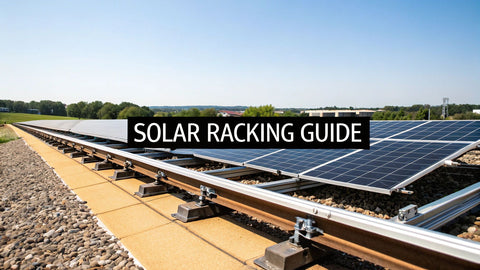
Don't forget the mechanical side. Denser modules mean fewer clamps and rails per kW, but roof-loading and wind calculations still rule the layout. Our racking systems buyer's guide covers attachment engineering, and rooftop installation basics covers the field workflow. When you're ready to source, compare channels in buying solar panels online versus buying direct from manufacturers.
One more design note that catches people: DC-to-AC ratio. High-efficiency modules invite aggressive oversizing — a 1.3:1 array-to-inverter ratio is common and usually smart — but with premium low-degradation panels, that ratio stays productive longer because the array's year-15 output remains higher than a commodity array's. If you're designing for storage, oversizing the DC side also feeds the battery more hours per day, which improves backup runtime and TOU arbitrage. Just confirm the inverter's maximum DC input current per MPPT; high-wattage bifacial modules can push Imp past 14A, and some MPPT inputs cap at 13–14A. Mismatch that pairing and you clip current every clear noon, donating your premium panel's advantage back to the sky.
Field Notes: What I've Learned Installing Premium Modules

My crew treats flagship glass-glass modules differently than commodity panels — the glass is heavier, the frames are stiffer, and a dropped corner costs real money. Budget an extra 10–15 minutes per installer-hour on handling for glass-glass product, and order 2–3% attic stock on any project over 100 kW because freight damage on premium glass is a schedule killer.
Second lesson: the datasheet bifacial boost doesn't exist on a shingled roof. Bifacial gains need albedo — white TPO, gravel, ground — and rear-side clearance. On flush-mount residential, pay for front-side efficiency only. On commercial flat roofs with white membrane, bifacial TOPCon is the best $/kWh in the business right now.
Third: verify the warranty administrator, not just the warranty. A 25-year product warranty from a manufacturer with no US service presence is a sheet of paper. Cross-check tier status and bankability in our Tier 1 solar panel explainer and the current Tier 1 manufacturer list, and read solar panel warranty essentials before you sign a purchase order.
High-Efficiency Panels by Application: Where Each Tier Wins
Residential Rooftops
Residential is where high efficiency earns its keep most reliably. A typical US home has 300–600 sq ft of usable, unshaded roof face. At 20W per sq ft (commodity), that's 6–12 kW; at 23W per sq ft (flagship), it's 7–14 kW from the identical footprint. When a household needs 11 kW to offset its usage and the roof only delivers it with premium panels, the premium isn't optional — it's the whole project. Aesthetics matter here too: all-black back-contact modules with no visible busbars sell jobs that silver-framed commodity panels lose.
Commercial and Industrial Rooftops
C&I math runs on $/kWh and demand-charge reduction, not curb appeal. Bifacial TOPCon over white TPO membrane is the current sweet spot: 21.8–23% front-side efficiency plus a measured 5–12% rear-side gain from roof albedo, at only a few cents per watt over commodity. Structural loading often caps C&I arrays before area does — older roofs may be rated for only 3–4 psf of added dead load, and high-efficiency panels deliver more watts per pound of steel and glass. Fewer, denser modules also mean fewer roof penetrations, which every roofer and every warranty department appreciates.
Off-Grid and Space-Critical Builds
Cabins, RVs, telecom shelters, and remote pumping stations live and die by watts per square foot. Off-grid designers pair premium modules with MPPT charge controllers sized to harvest every watt — our MPPT vs PWM controller guide and charge controller sizing guide cover that side of the system. In a 1,200W RV roof build, stepping from 20% to 23% modules adds roughly 180W — enough to run a refrigerator through a cloudy afternoon that would otherwise drain the battery bank.
Procurement Checklist: Buying Premium Modules Without Getting Burned
Premium pricing attracts premium gamesmanship. I've opened containers where the top two layers were the quoted module and the bottom layers were a lower-wattage bin of the same frame — the paperwork said 460W, the flash labels said 445W. Here is the checklist we run on every high-efficiency buy:
- Flash-test data per pallet. Require the manufacturer's flash CSV before payment. Check that Pmax bins match the purchase order and that spread inside a pallet stays within ±5W.
- Serial verification. Scan a random 10% of modules against the manufacturer's serial database. Legitimate Tier 1 factories resolve serials instantly.
- Certification match. UL 61730 listing, and for racking attachment, UL 2703/3741 compatibility with your chosen system. A premium panel on an uncertified racking pairing fails inspection just as dead as a cheap one.
- Warranty entity. Confirm who administers the warranty in the US and whether the manufacturer carries insurance-backed warranty coverage. Read the fine print with our solar panel warranty guide open next to you.
- Degradation schedule in writing. The warranted year-1 and annual degradation numbers should be printed in the warranty document, not just the marketing deck.
- Bankability cross-check. Verify current Tier 1 status against the 2025 Tier 1 list before committing project financing.
Five Mistakes That Erase the High-Efficiency Advantage
1. Ignoring the temperature coefficient. Buying on STC efficiency alone in Phoenix or Houston hands back half your premium every summer afternoon. Compare Pmax temperature coefficients first, nameplate second.
2. Overvolting strings in cold climates. High-Voc premium modules plus an uncorrected string calculation equals a fried inverter input stage. Run the NEC 690.7 correction for your record-low ambient every time.
3. Pairing premium panels with bargain racking. A $0.12/W premium panel on a racking system that flexes under snow load will microcrack cells within two winters. Match component quality across the BOM — see our racking systems guide.
4. Skipping module-level electronics on shaded roofs. A 24% efficient module behind a chimney shadow produces like a 19% module. On complex roofs, microinverters or optimizers protect the premium you paid.
5. Buying wattage bins you didn't specify. Always specify the exact power bin and positive tolerance on the PO. "460W ±5W" is not the same product as "460W, 0/+5W."
Maintenance: Protecting a Premium Asset
Premium modules justify slightly more disciplined O&M because each panel carries more production. Annual inspection, soiling checks, and thermal scans catch problems while warranty claims are still painless. Our solar panel maintenance guide lays out the full schedule, and how to test solar panel output covers field verification with a multimeter and clamp meter. In dusty markets, a cleaning cadence of twice yearly typically recovers 3–5% of annual yield on premium glass — at 460W per panel, that recovery is worth more than the cleaning costs on any array above 20 kW.
25-Year Value Comparison: Premium vs Commodity on the Same Roof
Let's close the loop with a full-lifecycle comparison. Assume a 10 kW residential array, 1,450 kWh/kWp year-one yield, $0.16/kWh retail power, and a roof that fits exactly 10 kW of either option. The premium TOPCon option costs $800 more in modules but produces more energy in year 25 because of its slower degradation curve.
| Metric | Commodity PERC (2.0% / 0.55%) | Premium TOPCon (1.0% / 0.40%) | Advantage |
|---|---|---|---|
| Year-1 production | 14,210 kWh | 14,355 kWh | +145 kWh |
| Year-25 retention | ~85.5% | ~87.4% | +1.9 pts |
| Year-25 production | ~12,150 kWh | ~12,546 kWh | +396 kWh |
| 25-yr cumulative production | ~330,600 kWh | ~337,900 kWh | +7,300 kWh |
| 25-yr energy value @ $0.16 | ~$52,900 | ~$54,060 | +$1,160 |
| Module premium | — | +$800 | Net +$360 |
Checked math on the cumulative figures: PERC loses 2.0% in year one, then 0.55% compounded for 24 years — a geometric series summing to roughly 33.06 times the year-one output; TOPCon at 1.0% then 0.40% sums to roughly 33.79 times. The delta, about 7,300 kWh over 25 years at flat $0.16/kWh, is $1,160. Against an $800 module premium, the premium wins even before you count escalation in retail rates — and at 3% annual rate escalation, the gap widens to roughly $1,500. On constrained roofs where premium panels enable a larger array, the case isn't close.
Orientation and tilt still dominate everything else. A premium panel aimed west underperforms a commodity panel aimed south at the right tilt — get the geometry right first with our panel direction and tilt guide, then spend the efficiency premium.
Construction Details: Half-Cut Cells, Bifacial Glass, and Why They Matter
Modern high-efficiency modules share construction DNA worth understanding. Half-cut cells split each cell in two, halving cell current and cutting resistive losses — the reason a 144-half-cell module squeezes an extra percent or two from the same silicon. Multi-busbar designs (9–16 busbars) shorten electron travel and improve shade tolerance. Bifacial dual-glass construction replaces the polymer backsheet with glass, enabling rear-side harvest and improving fire ratings and long-term moisture resistance — dual-glass modules dominate the premium tier partly because they simply survive longer. These construction choices show up indirectly in warranty terms: manufacturers confident in their encapsulation and glass offer 30-year product warranties; those less confident stop at 12–25 years. Read the warranty length as a proxy for build quality, because the manufacturer has already priced their own risk.
The Bottom Line for Buyers
High-efficiency panels earn their premium when space, structure, or per-panel soft costs constrain your project — and they're the wrong spend when land is free and racking is cheap. The buying sequence that works: fix the geometry (tilt, azimuth, shading) first; choose the architecture (string, micro, hybrid) second; then select the module tier the site actually rewards. Verify cold-temperature string math against NEC 690.7, verify the warranty entity and Tier 1 status in writing, and buy from a supplier whose replacement logistics you've actually tested. Do those things and the premium panel is the cheapest panel you'll ever own — measured in dollars per delivered kilowatt-hour across twenty-five summers, which is the only metric the sun respects.
Frequently Asked Questions
Are high-efficiency solar panels worth the extra cost?
When roof area, structural capacity, or balance-of-system costs per panel constrain your project, yes — the density premium typically pays back in under three years of extra production. On land-rich ground mounts, commodity modules usually win on pure $/W economics.
How much more power does a 23% panel make than a 21% panel?
Roughly 9.5% more per square meter at nameplate ((23−21)/21 = 9.5%). After temperature and degradation differences, premium n-type panels often hold or slightly widen that gap over 25 years because of better temperature coefficients and slower degradation.
Do high-efficiency panels degrade slower?
Generally yes. N-type architectures (TOPCon, HJT, IBC) are largely immune to light-induced degradation and typically carry first-year degradation near 1.0% with 0.35–0.40% annual decline, versus about 2.0% and 0.55% for mainstream PERC.
What efficiency should I look for in 2026?
For residential rooftops, 22%+ from a TOPCon or back-contact module. For commercial flat roofs, bifacial TOPCon in the 21.8–23% band delivers the strongest $/kWh. Anything below 21% should be priced at a meaningful discount.
Do high-efficiency panels need special inverters?
No special inverter is required, but their higher string voltages demand careful NEC 690.7 cold-temperature correction, and their output justifies quality MPPT electronics. Always verify string length against the inverter's maximum input voltage with the corrected Voc.
Where can I buy high-efficiency panels at wholesale?
PES Supply stocks Tier 1 high-efficiency modules for installers and commercial buyers — contact our team for current availability, pallet pricing, and freight quotes, or browse our commercial solar building guide for project-level planning.
Need pricing or availability on anything in this guide?
Portlandia Electric Supply dropships direct from the manufacturer — most items Ship Direct with lead times stated up front, no surprises.
Get a quote from PESBulk, pallet and contractor pricing available.