Updated September 2026 — refreshed against the live PES catalog; product pricing verified 2026-09-26.
A generator is the only machine most people buy hoping never to use — and that is exactly why generators die. They sit for eleven months, the battery sulfates, the fuel varnishes, a mouse builds a nest in the air box, and the first real outage of the year becomes a service call. After years of shipping units and fielding the Monday-morning phone calls after storms, I can tell you the pattern is nearly perfect: the generators that fail are the ones nobody touched since installation. This guide lays out the maintenance rhythm that actually works, across the brands we stock — Generac, Briggs & Stratton, Champion, Kohler, Cummins — with the schedules, oil specs, and cost math to keep your unit starting on the first crank for its full design life.

The Four Rules of Generator Survival
- Exercise it — weekly automatic exercise on standby units; monthly 30-minute loaded runs on portables
- Feed it clean fuel — stabilized gasoline under 6 months old, treated diesel, or plumbed gas
- Change the oil on schedule — break-in change early, then annual or per-hour intervals
- Mind the battery — the #1 cause of no-start failures; replace every 2–4 years, not when it dies
Why Maintenance Is Not Optional

Standby generators are insurance policies with engines. The failure statistics from service networks are remarkably consistent: dead starting batteries and stale fuel account for the large majority of no-start failures — both cheap, both preventable. Beyond reliability, there is a financial angle most owners miss: manufacturer warranties require documented maintenance. A skipped oil-change log can turn a covered $2,000 stator replacement into an out-of-pocket invoice, a dynamic we break down in the Generac warranty explainer. Maintenance is not a chore list; it is what keeps the warranty alive and the machine ready.
The Master Maintenance Schedule

Intervals below are representative of the residential standby and portable classes — your model's manual controls, and liquid-cooled units run longer intervals between some items. (For the portable-specific version, see our portable generator maintenance guide.)
| Interval | Air-Cooled Standby (10–26 kW) | Liquid-Cooled Standby (22 kW+) | Portable |
|---|---|---|---|
| Weekly | Automatic self-exercise (12 min typical); check for alarms | Automatic exercise; review monitoring app | — |
| Monthly | Visual: oil level, leaks, enclosure, pest intrusion | Visual: coolant, oil, belts, enclosure | 30-min run at ~50% load if unused |
| Break-in | Oil & filter at ~25 hrs | Oil & filter per manual (~50 hrs) | Oil at ~20 hrs |
| Annual / 100–200 hrs | Oil, filter, air filter, spark plugs; valve lash check where specified; battery load test | Oil, filters, coolant test; belt/hose inspection; battery load test | Oil, air filter, spark plug; fuel system service |
| Every 2–4 yrs | Battery replacement; firmware updates | Battery; coolant flush per schedule | Battery (electric-start models) |
One habit worth building: run the unit under real load, not just no-load exercise, at least quarterly. Light or no-load running — especially on diesel units like the XD5000E-class diesels — leads to wet stacking and carbon buildup. Thirty minutes at half load burns off moisture in the oil and proves the machine makes power, not just noise.
Oil: The Right Viscosity for Your Climate

Oil choice is climate-dependent, and the owner's-manual chart exists because the wrong viscosity causes hard starts in January and thin protection in August. The typical small-air-cooled-engine chart (confirm against your manual):
| Oil Type | Ambient Temperature Range | Best Use |
|---|---|---|
| SAE 5W-30 full synthetic | −20°F to 100°F | Best all-climate choice; superior cold cranking |
| SAE 10W-30 | 0°F to 100°F | Moderate climates; conventional fill |
| SAE 30 | Above 40°F | Warm climates only — cold-start risk below 40°F |
We recommend full synthetic 5W-30 for any unit that might start below freezing — which is to say, nearly all of them. Synthetic costs a few dollars more per change and buys measurably easier cold cranking plus better protection during the long, hot full-load runs that summer outages produce. Whatever you choose, use the OEM filter: we have seen off-brand filters with weak anti-drainback valves starve engines at startup, a failure that arrives silently and costs a crankshaft.
Servicing by Brand: What Each One Asks For

Every major brand follows the same physics, but the details differ. What we tell customers for each line we stock:
| Brand | Maintenance Personality | Watch-For Items |
|---|---|---|
| Generac (Guardian / Protector) | Weekly exercise built in; Mobile Link monitoring; dealer activation required | Keep firmware current; document every service for warranty claims; OEM maintenance kits simplify annual service |
| Briggs & Stratton | InfoHub monitoring on newer units; value-priced parts | Check valve lash on schedule; verify exercise clock is actually set after power outages to the unit itself |
| Champion | Straightforward DIY-friendly design; strong parts availability | Model-specific maintenance kits (e.g., 12.5 kW service kits) — confirm serial-number breaks before ordering |
| Kohler | OnCue monitoring; hydraulic valve lifters on many models reduce lash adjustments | Premium parts pricing — budget annual service accordingly |
| Cummins (QuietConnect) | Commercial-grade build; long service intervals | Professional service network is smaller in some regions — line up a servicer before you need one |
For deeper brand-level detail, see our Briggs & Stratton brand guide, the Champion brand guide, and the Cummins brand guide for professionals. Liquid-cooled units above 22 kW have their own rhythm — covered in the liquid-cooled standby overview.
How to Do the Annual Service Yourself (Air-Cooled Standby)

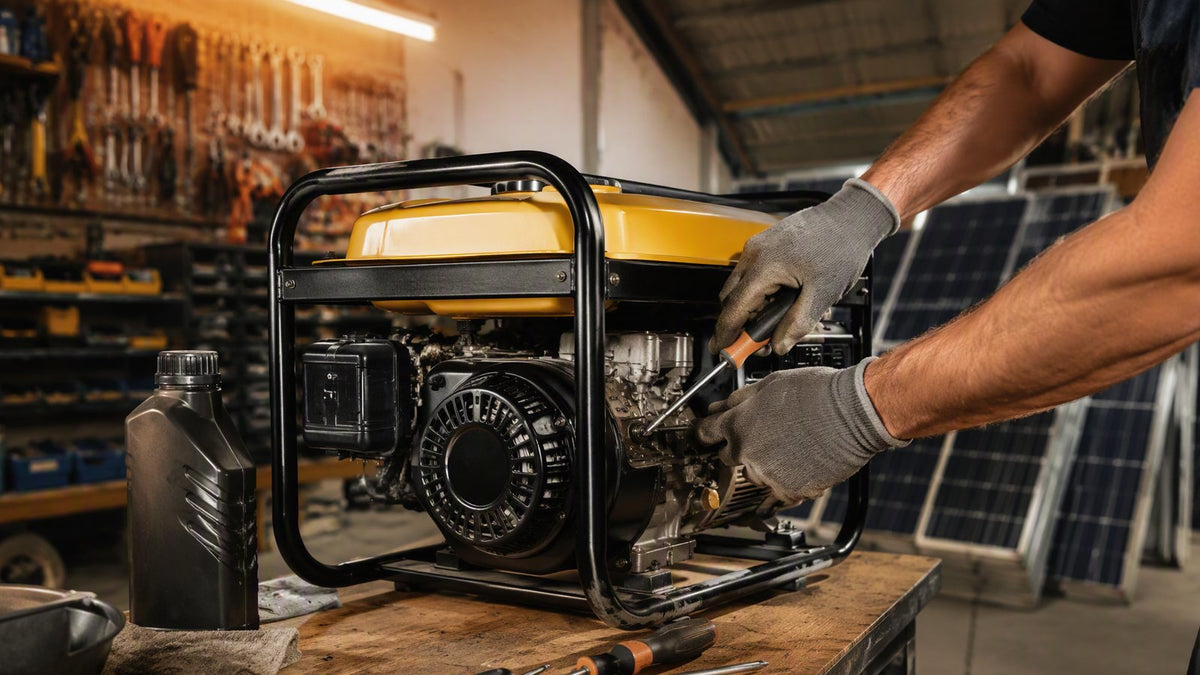
A competent DIYer can handle the annual service on an air-cooled standby unit in about an hour. The sequence:
- Disconnect power safely. Switch the unit to OFF at the controller, remove the 7.5A controller fuse, and disconnect the battery negative terminal first. The unit can auto-start while your hands are inside if you skip this.
- Warm the engine, then drain. A brief run warms the oil so it drains fully. Drain via the hose or plug into a pan — expect roughly 1.7–2 quarts on most residential air-cooled engines.
- Replace the filter. Pre-fill the new OEM filter, smear the gasket with fresh oil, hand-tighten per the filter's instructions.
- Air filter and plugs. Inspect or replace the air filter; gap new plugs to the manual's specification (commonly 0.030 in on these engines) and torque to spec, not feel.
- Refill and verify. Refill with the viscosity from the chart above, run the unit two minutes, shut down, wait, and check the dipstick. Inspect for leaks at the filter.
- Battery and log. Clean terminals, verify the charger output, load-test if the battery is past year two. Then write it all down: date, hours, oil type, filter part number. That log is your warranty armor.
- Restore service. Reconnect the battery (positive first on reconnection), reinstall the fuse, return the controller to AUTO, and confirm the next exercise cycle is scheduled.
When in doubt, hire it out: a botched valve adjustment or a cross-threaded drain plug costs more than a decade of professional service calls.
Generator starting batteries live a brutal life: float-charged continuously, cycled rarely, baked in summer and frozen in winter. They sulfate quietly and fail without warning — usually during the year's worst storm. The rules that work:
- Replace on a schedule, not on failure: every 2–4 years depending on climate, sooner in hot enclosures.
- Test annually: a load test or a conductance tester reading, not just voltage — 12.6V on a dead-cell battery means nothing.
- Verify the charger: the on-board charger should hold float voltage in the 13.2–13.8V range; a failed charger kills a new battery in a season.
- Carry the right group size: most residential standby units use a Group 26R or 51R class battery; check the manual before the store run.
Fuel System Care by Fuel Type

Gasoline (portables): the carburetor is the failure point. Use ethanol-free fuel where available, add stabilizer at every fill, and either run the carb dry or drain it before storage past 60 days. Stale fuel is the single most common portable-generator repair.
Natural gas / propane (standby): no storage degradation, but verify gas pressure annually — utilities occasionally alter service, and a starved unit under load throws undervoltage faults. LP tank regulators and pigtails age; have them inspected with the tank.
Diesel: treat stored diesel with biocide and stabilizer, drain the water separator annually, and polish or replace fuel older than 18 months. Fuel-specific tradeoffs are covered in natural gas vs. propane vs. diesel.
DIY vs. Professional Service: The Cost Math

| Approach | Annual Cost (typical) | Best For |
|---|---|---|
| Full DIY (parts only) | $60–$120 | Handy owners; air-cooled units; portable owners |
| Annual pro service visit | $250–$450 | Most standby owners; warranty documentation |
| Service contract (planned) | $300–$600/yr | Commercial sites; rental properties; peace of mind |
| Neglect (the "do nothing" plan) | $0 until $800–$2,500 | Nobody — battery + carburetor + stator failures compound |
I have taken the call where the "do nothing" plan matured during a five-day outage — dead battery, varnished fuel, and a family driving to a hotel while the food thawed. The $60 of parts would have prevented the whole story. Whatever route you choose, put the service month on the same calendar as your smoke-detector batteries, and keep the receipts in one envelope. Future-you, standing in a dark house during an ice storm, will be grateful.
Maintenance schedules keep a generator healthy; the seasonal playbook keeps it relevant. Before storm season — hurricane months on the Gulf and Atlantic, ice season in the Midwest and Northeast — run a full dress rehearsal: start the unit, transfer the load, let it carry the house for thirty minutes, then transfer back and check for leaks, alarms, and fuel level. On portables, that rehearsal includes fresh fuel, a verified cord set, and knowing which inlet or interlock you'll use before the lights go out, not after.
After any long run, the unit needs attention: check the oil after every 24 hours of continuous operation on air-cooled engines (they consume some by design at full load), let the machine cool before refueling a portable, and log the hours against the next service interval. A week-long outage can burn through an entire annual service interval in one event — the manual's hour-based schedule doesn't care what month it is.
Two failure sources never appear in the brochure. The first is rodents and insects: mice nest in warm air boxes and chew wiring insulation, and mud daubers pack vents with nests that block cooling. A monthly glance inside the enclosure and a $15 roll of pest-resistant screening over intake openings prevent both. The second is vegetation and snow: shrubs grow into clearances over a summer, and drifts bury exhaust outlets in a night. Maintain the manual's clearances — typically 18 inches minimum at the sides and five feet at the exhaust end — as a landscaping rule, not a suggestion. I've fished a full wren's nest out of a standby unit's intake in April; the homeowner had no idea the weekly exercise was suffocating the engine a little more each time.
A closing thought from years of these conversations: the best-maintained generators we see belong to owners who treat the machine like a vehicle, not an appliance. They know the hour count, they hear the change in exhaust note when something is off, and they call about a slow crank in June instead of a no-start in January. You do not need to become a mechanic — you need to become someone who notices. The schedules and tables in this guide are the how; the noticing is the habit that makes the how unnecessary to improvise under pressure.
And when a unit does reach the end of its service life — twenty-plus years for a well-maintained standby — the maintenance record you kept becomes a selling point at replacement time. A documented machine trades up faster, and the dealer who services it knows exactly which model class to quote next.
How often should I service my standby generator?
Annual service is the baseline for air-cooled standby units (oil, filter, plugs, battery test), with a break-in oil change around 25 hours on a new unit. Liquid-cooled units follow automotive-style intervals per their manuals. Units that run long outages need mid-event oil checks — a week of continuous running can consume a full service interval.
What oil does a Generac, Briggs & Stratton, or Champion generator take?
Most residential air-cooled engines across these brands specify SAE 5W-30 full synthetic for all-climate use, 10W-30 above 0°F, or straight SAE 30 above 40°F. Capacities run roughly 1.7–2 quarts with filter. Your model's manual controls — check it before the first change.
Why won't my generator start after sitting all year?
Almost always one of three culprits: a sulfated starting battery (the #1 cause), stale or varnished fuel clogging the carburetor on gasoline units, or a fouled spark plug. All three are prevented by the monthly exercise habit and annual service — replace the battery every 2–4 years on schedule.
Does skipping maintenance void my generator warranty?
It can. Manufacturer warranties require documented maintenance per the model's schedule, and "recommended" becomes "required" the moment a claim is filed. Keep dated receipts and a written log of every oil change, filter, and battery replacement — undocumented maintenance is among the most common warranty denial reasons.
Should I run my generator under load or just let it exercise?
Both. The weekly automatic exercise keeps seals and windings healthy, but add a quarterly 30-minute run at roughly half load. Loaded running burns condensation out of the oil and prevents wet stacking on diesel units, and it proves the machine produces power — not just noise — before you need it.
Can I service my generator myself?
The annual basics — oil, filter, air filter, plugs, battery — are within reach of a careful DIYer on air-cooled and portable units: disconnect the controller fuse and battery first, follow the manual's specs, and log everything. Valve adjustments, liquid-cooled systems, and anything involving the transfer switch belong to a qualified technician.
- Generac Generators & Maintenance Kits
- Briggs & Stratton Collection
- Champion Generators
- Whole-Home Generator Sizing Guide
Need Parts, Kits, or a Replacement Unit?
PES Supply stocks maintenance kits, batteries, transfer switches, and generators from every major brand — one PO, freight nationwide.
Get a Free Quote